EMT Practice Test

1. Question Content...


Question List

Question1: Which of the following is the element of a value stream stage that describes the state change that triggers the value stream stage?

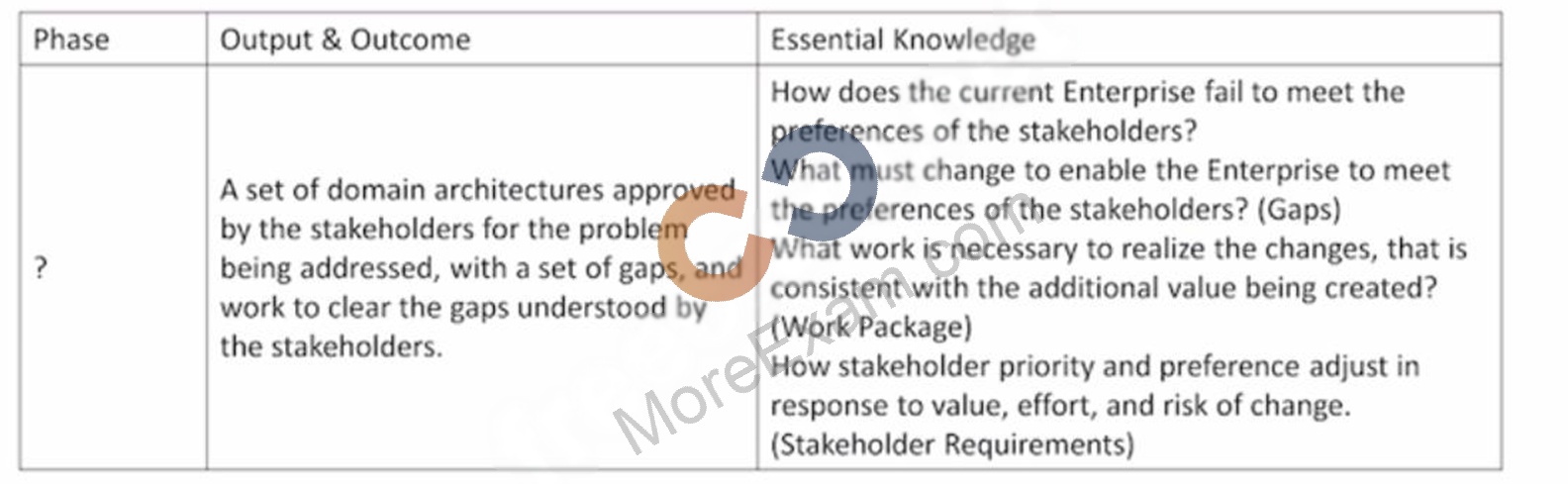
Question2: Refer to the table below:

Which ADM Phase(s) does this describe?

Question3: Consider the following Business Capability Example:

Which of the following are A and C?

Question4: Which statement best describes iteration and the ADM?

Question5: Which ADM Phases match the following purpose descriptions?

Question6: Which of the following is a difference between an organization map and an organization chart?

Question7: Which of the following best summarizes the purpose of Enterprise Architecture?

Question8: Consider the following example using the Business Model Canvas:

What are the segments labeled A, D and I?

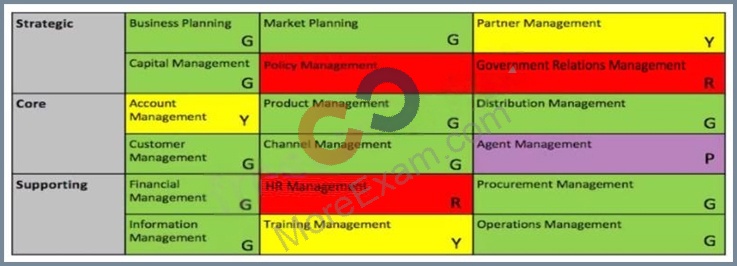
Question9: Consider the following business capability map. where cells of a model are given different colors to represent desired maturity levels (Green (G) = level achieved, yellow (Y) = one level away, red (R) =two or more levels away, purple (P) = missing capability):

Which of the following best describes what this shows?

Question10: Which of the following describes how business models are used within the TOGAF standard?

Question11: Which of the following best describes the relationship between business models and business architecture?

Question12: Which step during development of a business scenario ensures that each iteration is managed as a mini-project?

Question13: Which of the following is a purpose of mapping capabilities to value stream stages?

Question14: Which of the following is guidance for creating value streams?

Question15: Which approach to model, measure, and analyze business value is primarily concerned with identifying the participants involved in creating and delivering value?

Question16: Which of the following can be used to help define information concepts in an information map?

Question17: What process is used to decompose a set of business capabilities to communicate more detail?

Question18: Which of the following supports the need to govern Enterprise Architecture?

Question19: Consider the following business capability map. where cells of a model are given different colors to represent maturity levels (note the letters G, R. Y. P also denote the colors used = Green, Red. Yellow and Purple):

Which of the following best describes this technique?

Question20: Which of the following is a benefit of organization mapping?

Question21: Which of the following is a benefit of information mapping?

Question22: Consider the diagram of an architecture development cycle.
Which description matches the phase of the ADM labeled as item 2?

Question23: What Business Architecture concept is most related to an information Map?
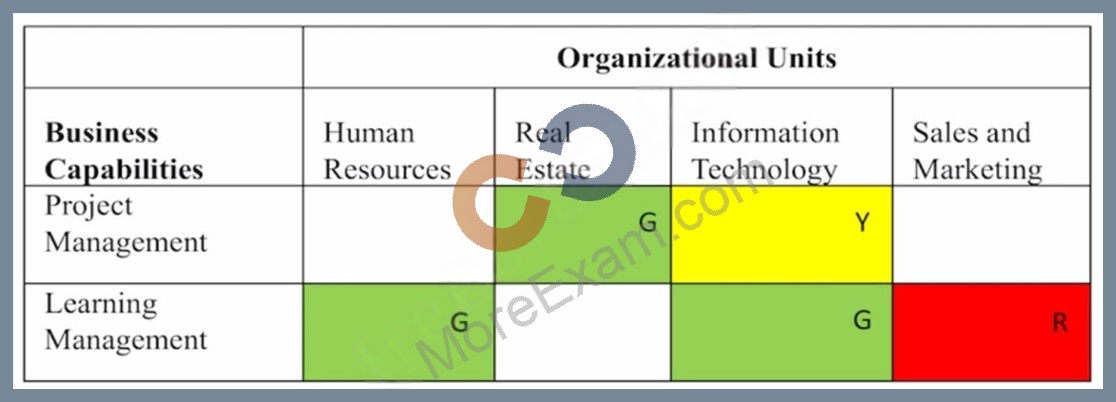
Question24: Consider the following modeling example, relating business capabilities to organization units so as to highlight duplication and redundancy:

(Note in this example the cells colored green, yellow, and red, are also marked G. Y, and R, respectively) Which of the following best describes this technique?

Question25: Complete the sentence. The TOGAF standard covers the development of four architecture domains. Business. Dat a. Technology and___________.

Question26: Consider the following graphic illustrating a method supporting the TOGAF ADM.

What does the method help identify?

Question27: In the diagram, what are the items labelled A, B, and C?

Question28: Complete the sentence. A business model is a description of the rationale for how an organization creates, delivers, and captures

Question29: Which of the following describes how the Enterprise Continuum is used when developing an enterprise architecture?

Question30: Consider the following example value stream:

What does this show?